
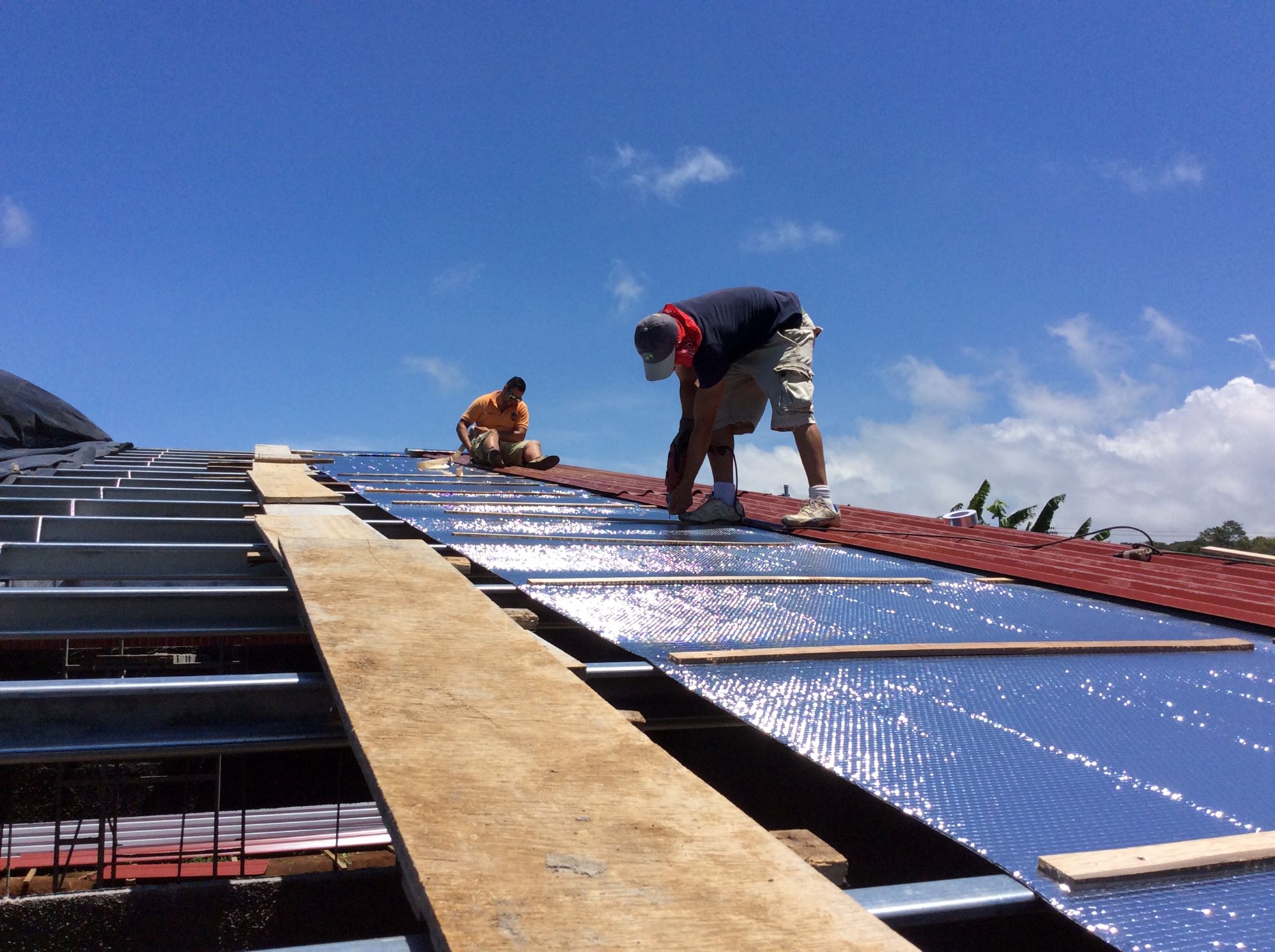
Foil Insulation Science for Metal Roofs & Airspace | InfraStop®
1. The Science Behind Radiant Barriers and Airspace
Before covering the practical benefits, let’s understand the science that creates the effectiveness of foil insulation when used with an airspace:
- Radiant Heat Reflection: Radiant heat transfer occurs when heat is emitted in the form of electromagnetic waves, typically in the infrared spectrum. Metal roofing, by nature, can absorb and re-radiate this heat, leading to temperature spikes inside your building. Foil insulation, however, is engineered to counteract this by reflecting radiant heat. When installed with an enclosed air space (even as thin as 3/4″), it creates a radiant barrier that effectively reflects heat away from your building.
- The Significance of Airspace: The concept of airspace in foil insulation is rooted in thermodynamics. A minimal amount of ¾” airspace or more plays a pivotal role in enhancing your building’s energy efficiency. When radiant heat is reflected by the foil insulation, the adjacent airspace acts as a buffer. It prevents the heat from transferring into your building’s interior, maintaining a more stable and comfortable temperature.
2. Foil Insulation for Insulating Metal Roofs – Cost-Effective Appeal
Now that we understand the science, let’s explore how this knowledge translates into practical benefits and cost savings when using foil insulation with metal roofing in pole barns and steel buildings:
- Energy Efficiency and Savings: Metal roofing, although cost-effective, can absorb and radiate heat, making your building uncomfortably hot in summer and leading to higher cooling costs. Foil insulation, with its radiant barrier properties, reduces heat absorption. This translates into significant energy savings over time.
- Condensation Control: Metal roofing is susceptible to condensation buildup, which can damage your structure and reduce its lifespan. Foil insulation serves not only as a radiant barrier but also as an effective vapor barrier when properly installed with airspace. This dual function helps prevent condensation issues, preserving the integrity of your building.
3. Table: Foil Insulation Applications – Metal Roofing Insulation
Below are two tables showing the various foil insulation applications and their benefits for metal roofing insulation. First table is for foil double bubble foil insulation. The seond table for white double bubble foil insulation. This table helps you understand the specific scenarios where foil insulation can be employed for optimal results, capitalizing on the science of radiant barriers and airspace. Choose an installation method for more specific installation.
Click the links in the table below:
| Application | Benefit | Air Space Specification | Where’s it Installed | Products |
|---|---|---|---|---|
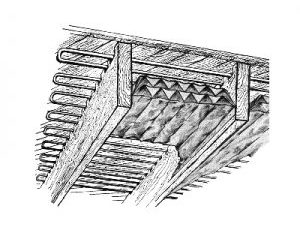
| Roof/New Above Purlin | R-6.8 Down R-4.3 Up | 0.75” (nominal) Above and Open Below | Install Above the Purlin | Foil both Sides |
| Roof/New Below Purlin | R-11 Down R-4.4 Up | 1.5” Above and Open Below | Install Above Truss and Below the Purlin | Foil both Sides |
| Roof/Retro Bottom of Purlin | R-11 Down R-4.4 Up | 1.5” Above and Open Below | Install on Bottom of Purlin | Foil both Sides |
| Roof/Retro Bottom of Truss | R-10 Down R-3.7 Up | 10” + Above and Open Below | Install on Bottom of Truss | Foil both Sides |
| Application | Benefit | Air Space Specification | Where’s it Installed | Products |
|---|---|---|---|---|
| Roof/New Above Purlin | R-3.8 Down R-3.5 Up | 0.75” (nominal) Above and Open Below | Install Above the Purlin | White one side |
| Roof/New Below Purlin | R-6.4 Down R-3.7 Up | 1.5” Above and Open Below | Install on Bottom of Purlin | White one side |
| Roof/Retro Bottom of Purlin | R-6.4 Down R-3.7 Up | 1.5” Above and Open Below | Install on Bottom of Purlin | White one side |
| Roof/Retro Bottom of Truss | R-6.6 Down R-3.0 Up | 10” + Above and Open Below | Install on Bottom of Truss | White one side |
Conclusion
In conclusion, when it comes to metal roofing insulation, the science behind radiant barriers and using an airspace is key to unlocking energy efficiency, cost savings, and long-term structural integrity. Whether you’re retrofitting or planning a new construction project, consider the benefits of foil insulation in conjunction with your metal roofing for optimal results. Using any of the applications above will result in a more comfortable, energy-efficient building that will be better protected.

Leave a Reply